Choosing garden equipment for year-round use is about more than simply filling a shed with tools. The key question is different: which equipment remains genuinely useful as conditions change, especially when watering is restricted by a prefectural order in the middle of the season? This article compares equipment categories based on how useful they remain under water restrictions and how durable they are across all four seasons.
Garden equipment and water restrictions: a comparison by category
In France, water restrictions depend on the severity of the drought and decisions made by the prefecture. They may limit watering hours, then impose tighter restrictions or even ban watering altogether. An automatic irrigation system bought in spring may be unusable by July.
For a clearer picture, this table ranks the main equipment categories according to how useful they remain—or how much their usefulness is reduced—under water restrictions.
| Equipment category | Usefulness without restrictions | Usefulness under water restrictions | Notes |
|---|---|---|---|
| Standard garden hose | High | None to very low | Banned from the heightened vigilance level onward in some departments |
| Drip irrigation | High | Moderate | Sometimes permitted during specific hours, depending on the local order |
| Outdoor rainwater collection tank | High | High | Not subject to the same restrictions as drinking water |
| Mulch (ground-covering material) | Moderate | High | Passively reduces evaporation without using water |
| Powered lawn mower / hedge trimmer | High | High | Not affected by water restrictions |
| Hand tools (spade, hoe, rake) | High | High | Essential in every season |
The conclusion is clear: passive equipment remains useful all year round, while systems that rely on mains water lose their value as soon as a restriction order is issued. Before investing, check local conditions on official drought-monitoring platforms to avoid buying equipment that cannot be used when it is needed most.
To explore the options available by category, Dédé’s garden equipment offers an overview organized by type of need.
Rainwater harvesting: an investment that goes beyond the tank
Most gardeners who install a rainwater collection tank do so after restrictions are announced. The purchase is often reactive rather than planned. The problem is that a tank alone does not make a functional system.
A case study published by La Voix du Nord on November 18, 2026, describes a community garden that combines water tanks, filtration, a pump, hoses and several collection points. This complete setup reduces reliance on drinking water far more than a simple rain barrel placed under a gutter.
The decree of July 12, 2024, and the associated health order govern domestic uses of rainwater. For garden use outdoors only, a system that is not connected to the home’s internal plumbing does not require the same procedures as an installation supplying household fixtures. This distinction is important to understand before buying.
- Outdoor tank with a lid and filter: simple to install, with no specific declaration required for garden use only
- Surface or submersible pump: needed if the tank is far from growing areas or buried underground
- Distribution hoses and fittings: choose a diameter compatible with a drip irrigation system to increase self-sufficiency
- Upstream filtration: needed to prevent drippers from clogging and extend the life of the system
Planning the complete system from the outset costs less than adding components over successive dry summers.
Mulch and ground cover: drought-proofing equipment for the vegetable garden
An article published by Le Parisien on November 26, 2026, looks at dry farming and ways to reduce water loss in the vegetable garden. These include mulching, enriching the soil with organic matter and providing shade. These practices broaden the definition of garden equipment. Protecting the soil can be just as worthwhile as investing in equipment to supply water.
Mulching is more than a cosmetic touch. A sufficiently thick layer of organic material (straw, wood chips, dead leaves) limits evaporation, regulates soil temperature and nourishes microbial life. It is an equipment category in its own right, just like a watering can or a spade.
For gardeners who want to work efficiently all year round, a garden shredder becomes a strategic tool. It turns pruning waste into free mulch. A shredder that pays for itself in two seasons replaces the need to buy mulch every year.
Powered tools: repairability as a criterion for a sustainable choice
Lawn mowers, hedge trimmers, chainsaws and shredders are often compared by power and price. One less obvious criterion deserves priority: the availability of spare parts for several years after purchase.
Regulations require manufacturers to make spare parts available for certain categories of powered tools for a minimum period. Checking the seller’s and manufacturer’s information on repairability before buying changes the way you think about your investment. A cheaper tool that cannot be repaired after three years costs more than a model whose blade or filter can be replaced for a decade.
- Check the repairability index displayed in store or on the online product listing
- Make sure the manufacturer has a spare-parts network available in France
- Choose brands that publish disassembly instructions and offer direct after-sales service
Hand tools for gardeners: choose quality in four key categories
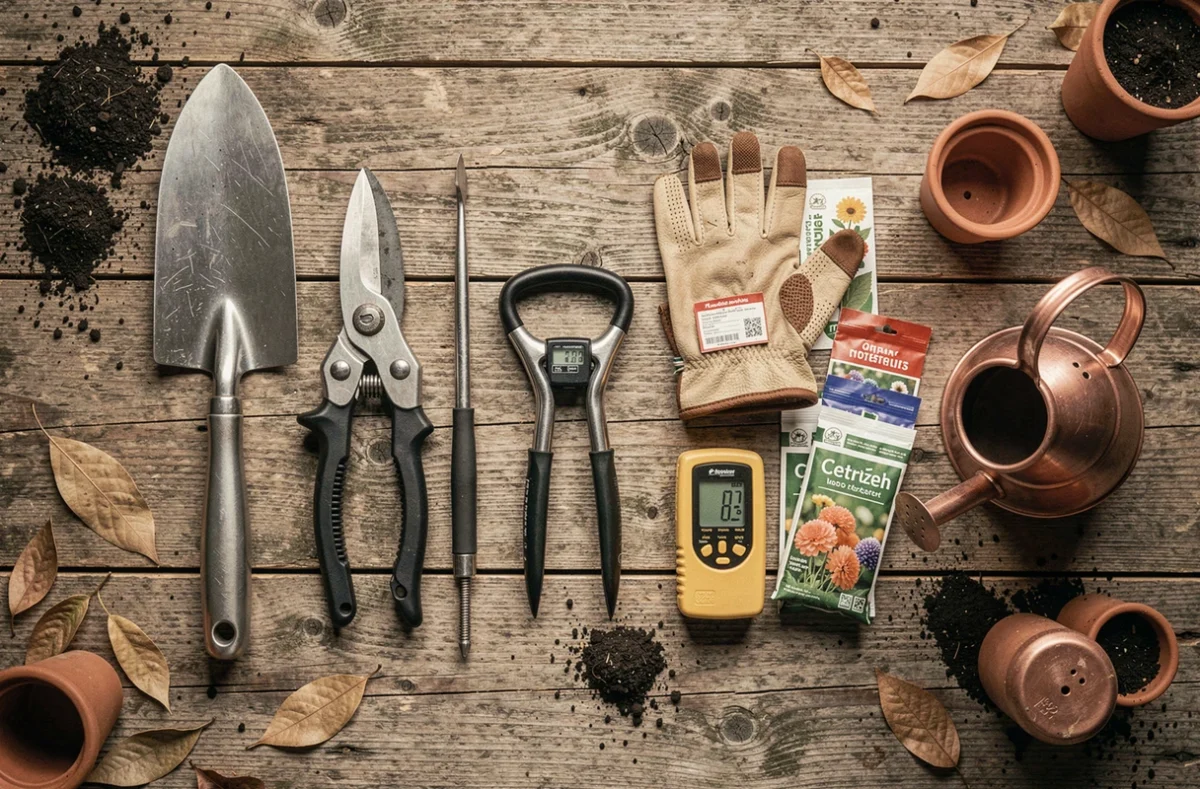
Spade, digging fork, hoe, rake: these tools last through the seasons without relying on water or electricity. Their lifespan depends almost entirely on the handle material and the quality of the steel.
A hardwood handle (ash, beech) absorbs vibrations better than a fiberglass handle, but requires annual maintenance (light sanding and linseed oil). A well-maintained hand tool can last for decades, whereas a low-end model may bend after just a few intensive uses.
The hoe and draw hoe deserve particular attention: these are the tools used to break up the soil’s surface crust. This simple action reduces evaporation between waterings, directly supporting the water-saving approach described above. Hoeing is the mechanical counterpart to mulching.
The most durable garden equipment is equipment that works in all conditions. With water restrictions becoming increasingly frequent, the most worthwhile investments are not the most obvious ones: a complete rainwater collection system, mulch, a shredder and quality hand tools provide a foundation that depends neither on an open tap nor on favorable weather.