
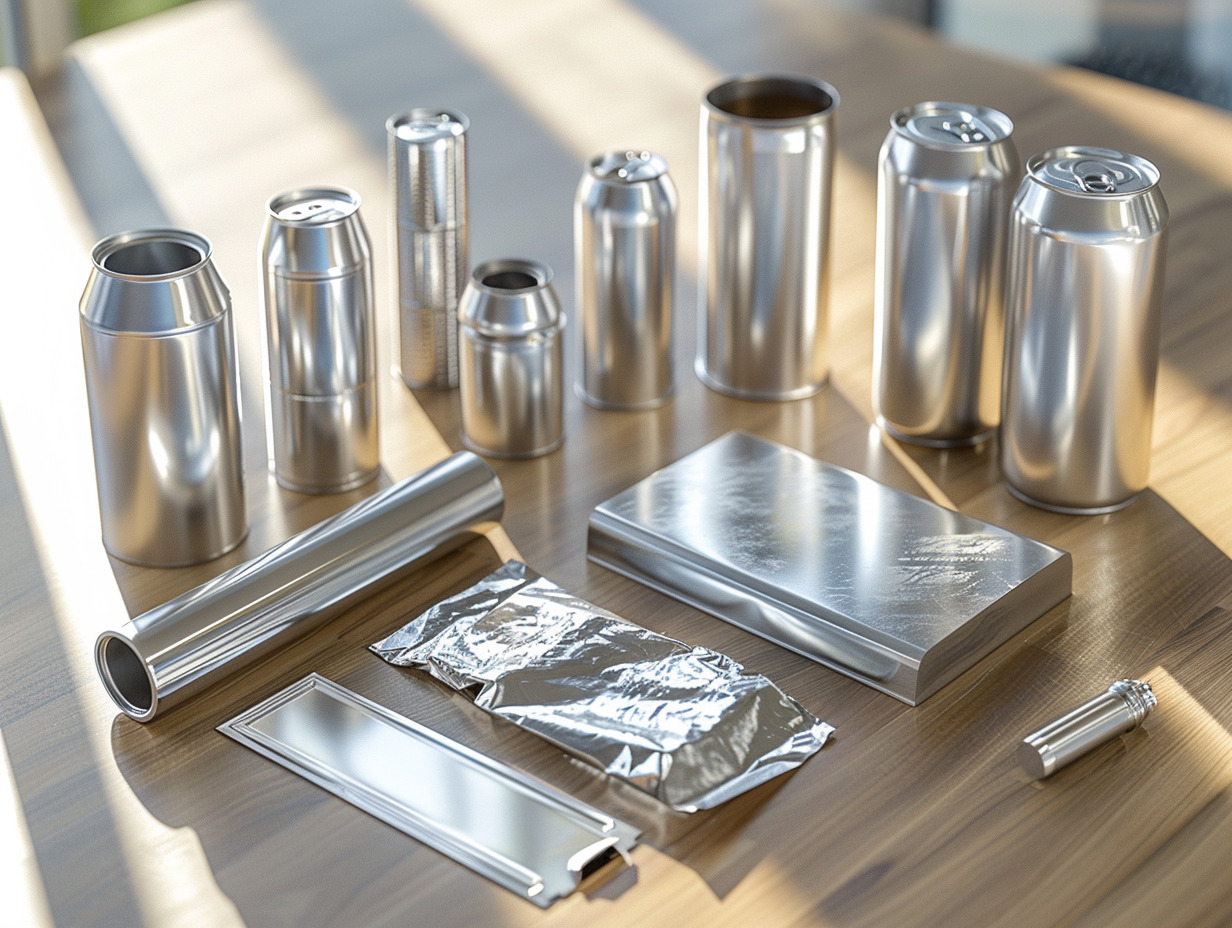
Aluminum, a lightweight and strong metal, is establishing itself in many sectors thanks to its unique properties. Derived from bauxite, it is valued for its malleability and electrical and thermal conductivity, while being non-magnetic and resistant to corrosion. Its ability to form alloys makes it extremely versatile, suitable for applications ranging from aerospace to food packaging. Its lightness, combined with significant strength, positions it as a preferred choice for structures requiring weight reduction without compromising solidity. Aluminum is infinitely recyclable, promoting its use in a sustainable development perspective.
Physical and Chemical Properties of Aluminum
The density of aluminum stands out for its lightness, with a density of 2.7 g/cm3, significantly lower than that of metals such as steel (7-8 g/cm3) or copper (8.96 g/cm3). This characteristic gives aluminum a significant advantage in applications where weight reduction is a priority, while maintaining appreciable structural rigidity. Its lightness, combined with its ability to form alloys with other metals like copper or zinc, enhances its versatility and relevance in various industries.
Finishes such as anodizing or powder coating are surface treatments that enhance aluminum’s resistance to corrosion and improve its aesthetics. These processes also enhance the durability of the material and its ability to maintain its new appearance over time, despite environmental aggressions. Despite these advantages, aluminum has some drawbacks, such as a high cost and lower impact resistance compared to other metals.
The thermal conductivity of aluminum is a property that makes it indispensable in areas where heat transfer is fundamental, such as heat exchangers or heat sinks in electronics. Its high conductivity, while advantageous in these applications, must be considered in contexts where insulation is necessary, as it can pose a technical challenge. Find innovative solutions to harness this conductivity while meeting the specific requirements of each application.
Applications and Challenges of Aluminum in Modern Industry
Construction is one of the fields that prioritize the use of aluminum, particularly due to its lightweight and corrosion-resistant properties. The various forms this metal can take, from profiles to sheets, allow its integration into elements such as joinery, verandas, as well as doors, roller shutters, and cladding. The combination of aluminum with other metals like copper and zinc leads to the creation of alloys with optimized characteristics for specific uses, such as renovation where aesthetics and ease of maintenance are paramount.
Aluminum recycling represents a key element of the circular economy, its characteristic being its complete recyclability. This advantageous property allows for a significant reduction in waste and contributes to more sustainable development, in harmony with current environmental goals. The life cycle of aluminum, from production to reuse, is part of an approach focused on energy efficiency and resource preservation.
Let’s discuss renewable energies: aluminum finds its place in wind or solar infrastructures, where its lightness and robustness are particularly appreciated. Consider the evolution of information technologies, where aluminum is ubiquitous in electronic components and cooling devices, thanks to its thermal conductivity.
In France, the aluminum sector is marked by a desire to strengthen innovation and competitiveness. Aluminum production must adapt to contemporary demands: cost reduction, performance improvement, and integration of ecological considerations. Keep a close eye on the publication of annual reports and corporate privacy policies to understand the economic impact of these developments on the national industry.