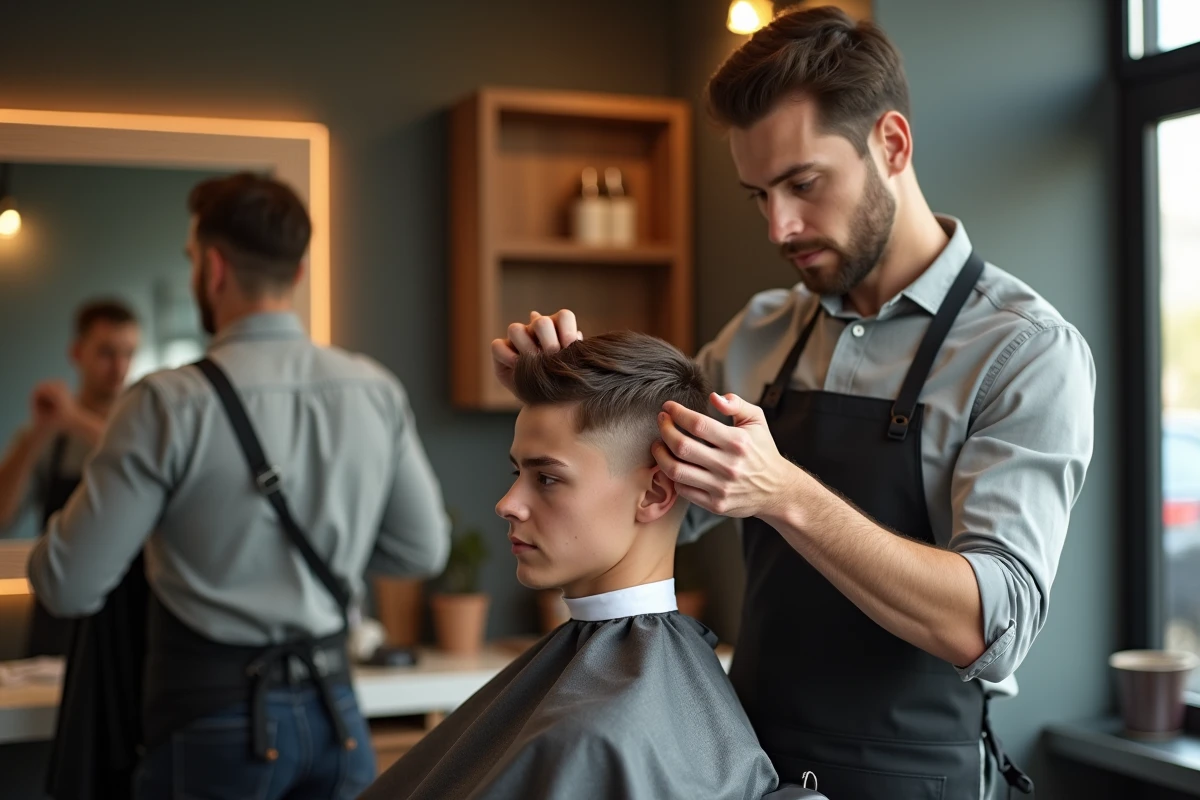
In some salons, the word “fade” refers to a technique that is completely distinct from “gradient,” while other professionals use it as a synonym. The confusion even seeps into training materials, where the two terms alternate without consistency.
The boundary between these styles is not just a matter of vocabulary. The differences lie in the method, the result, daily maintenance, and adaptation to morphology. Technical choices influence the final outcome and condition the advice given to each client.
Gradient or fade: what are the differences and why are these techniques so appealing?
Gradient or fade: the debate spans generations, sparks discussions in salons, and sometimes blurs the lines. The gradient, a pillar of modern hairstyling, structures the hair by creating levels, sometimes sharp, sometimes softer, that sculpt and provide contrast. Its goal? To bring relief, volume, shape the silhouette of a face or neck. On the other hand, the fade, or fade for English purists, pushes technical mastery even further: here, the transition almost completely disappears. The lengths go from the shortest to the longest without a visible demarcation. The eye perceives no break, only a subtle progression, as if the cut was designed to blend into the mass.
Why do these two techniques continue to prevail? Simply because they adapt to all desires and styles. The gradient, especially for men, has the art of highlighting the jawline, adding movement to straight hair, or energizing a classic look. The fade, on the other hand, appeals with its clean and sharp appearance, particularly on the nape and temples, a detail highly appreciated in urban and modern cuts.
Here’s what concretely distinguishes these two approaches:
- Gradient: visible transitions, play of volumes, more flexible maintenance, suitable for natural regrowth.
- Fade: completely blended transitions, skin-to-hair effect, precision required for impeccable contours.
When it comes to maintenance, we’re not playing in the same league. The fade requires more frequent appointments at the hairdresser to maintain the sharpness of its contours. The gradient, on the other hand, allows for gradual regrowth without losing its charm. For those who want to visualize the difference, a gradient explained on the blog clearly details the nuances between the two methods, with diagrams to support.
Each cut, each nuance responds to a specific expectation. Morphology, hair texture, desired result: everything matters. Prioritizing contrast or subtlety is choosing what reflects you.
The main styles of gradients for men: from fade to taper, how to find your way
The gradient has conquered the male scene, establishing itself as an essential reference. But behind this word lies a multitude of variants and technical details. Each style reflects a personality, a bold choice, a quest for precision in the hairdresser’s gesture.
The classic fade, also known as American gradient, descends from the temples to the nape, offering a smooth and clear transition. Its most radical version, the skin fade or white gradient, reveals the skin on the sides and accentuates the contrast between the base of the skull and the top. This effect, sometimes called white skin fade, highlights the precision of the cut and the care given to detail.
The choice of gradient type also depends on the height at which it starts. Here are the major options to consider:
- High fade: starts above the temples, structures the features, and accentuates the bone structure of the face.
- Low fade: begins below the ear line, for a more discreet effect and a soft transition.
- Mid fade: subtle balance between boldness and discretion, often recommended for all hair types.
Some styles stand out: the slick back gradient accompanies hair styled back, the French crop focuses on a short fringe, and the modern pompadour plays the card of maximum volume on top. Others, like the gradient with a line or the buzz cut, emphasize the geometry of the cut and offer a more pronounced result.
Ultimately, each type of gradient adapts to individual morphology and lifestyle. This choice, far from being trivial, shapes the image one projects, highlights the jawline, or softens contours according to needs.

Choosing and maintaining your gradient according to the shape of your face and your needs
The shape of the face strongly influences the choice of gradient. An oval face allows for almost all boldness: a mid gradient ensures a harmonious balance without breaking the natural line of the face. For square faces, the skin fade or high gradient highlights the jawline and energizes the contours. For an elongated face, it is better to keep some length on the sides to avoid accentuating the elongated effect.
But morphology is not everything. The texture and nature of the hair play a key role. Curly hair, for example, requires a precise fade so that the curls integrate harmoniously with the sharp lines of the cut. When the scalp is exposed or weakened, a specific wax helps maintain hydration and protection.
Maintaining a gradient is not improvised: one should plan touch-ups every two to three weeks, favor a gentle shampoo to preserve the fiber, and dry delicately without damaging the hair. To refine a clean look, a light wax or finishing paste can sculpt the material on top, depending on the desired effect.
The essential thing is to adapt the cut to one’s lifestyle. Some seek the precision of a line, others the softness of a fade or the ability to adjust their hairstyle according to the occasion. Observing how the gradient evolves over the days is also discovering a style that asserts itself and subtly reveals its own dynamics.
The next time you come across a flawless fade or a skillfully crafted gradient, remember: behind every cut, there is a story of details, gestures, and identity. Style here does not rely on a word, but on a visible choice even in regrowth.